

Wealth Management AI: Building an Intelligent Operating Layer for Advisors
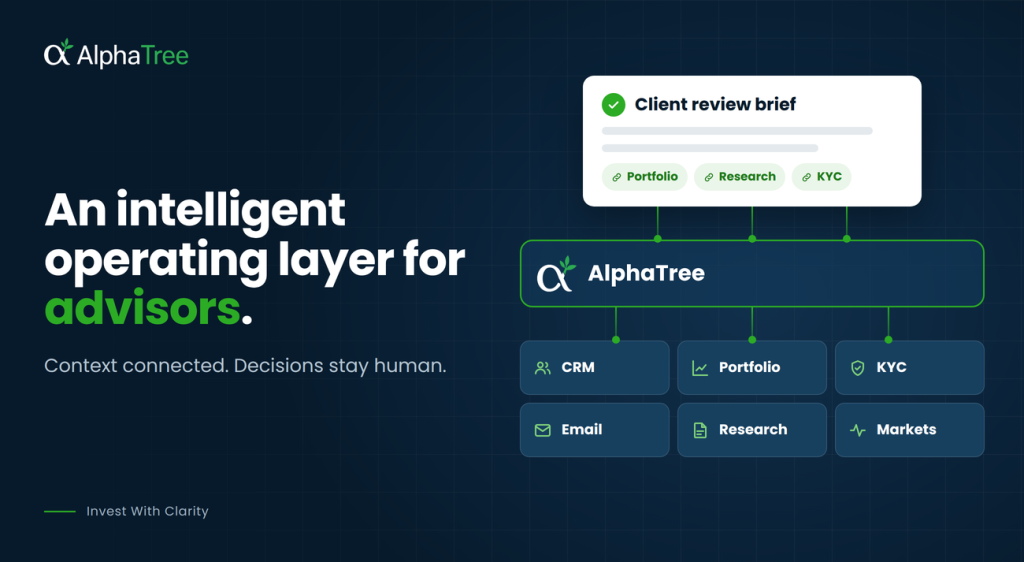
The most valuable wealth management AI is rarely the loudest. It helps an advisor enter a client review with a clear view of the relationship, portfolio, investment context and outstanding actions. It helps operations catch missing documents early and gives compliance a record of what happened. It turns scattered information into better-informed decisions without taking judgement away from the people responsible for advice.
For wealth and advisory firms, the opportunity is not simply to search faster or automate another task. It is to connect client context with portfolio activity, investment research, market developments and firm policies, then surface what matters when a decision or client conversation requires it.
An advisor rarely makes decisions from one source. A client conversation may depend on portfolio changes, market developments, research views, client objectives and firm policies. Wealth management AI can connect these pieces without turning judgement into an automated rule. This is not about adding a chatbot or promising autonomous advice; it is about making existing knowledge usable with the evidence, permissions and human review a regulated environment requires.
Why Fragmented Wealth Management Technology Holds Advisors Back
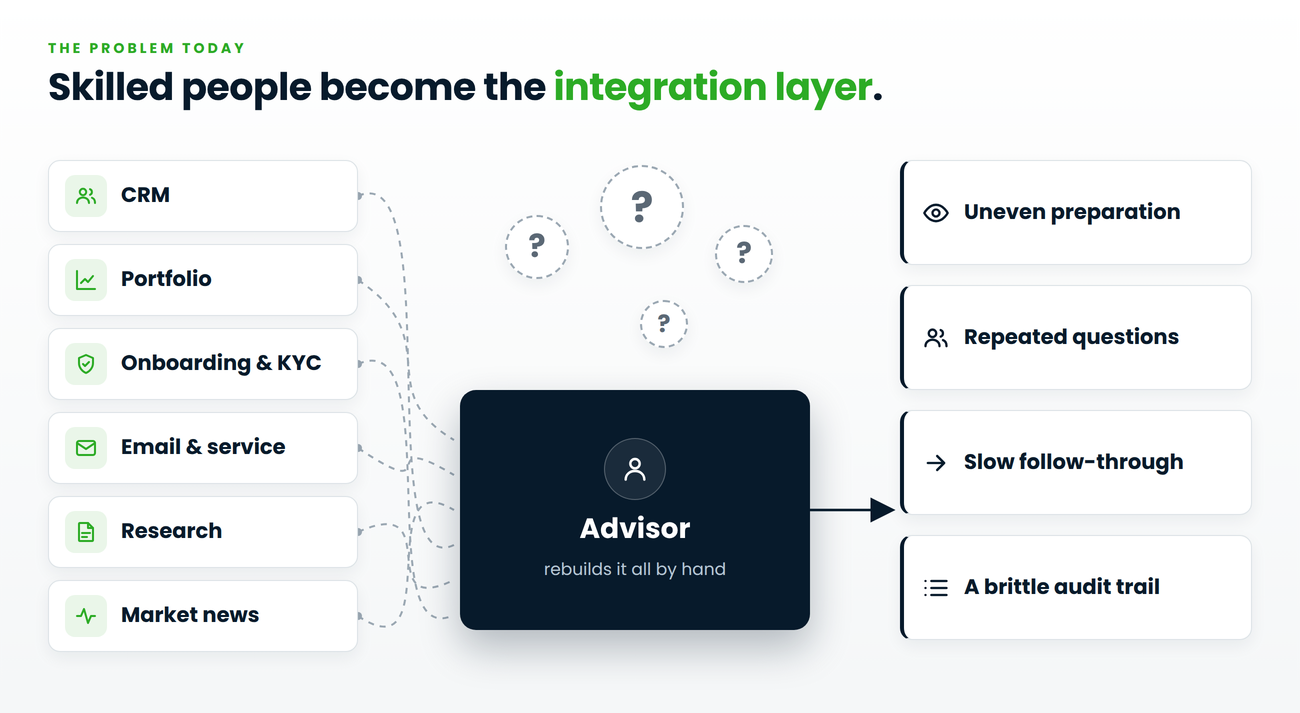
Consider a routine annual review. The advisor needs recent conversations, holdings, portfolio changes, open requests, KYC status, client goals and the investment context behind the recommendations being discussed. That information may be split across a CRM, portfolio systems, onboarding tools, service platforms, email, investment research and market intelligence sources.
The hidden work is rebuilding the story. Which client preference is current? Has the portfolio changed? Did new research alter the investment view? Is there a market development that matters for this client’s holdings? Which service or KYC issue still needs action? Repeated client after client, that effort leads to uneven preparation, repeated questions, slow follow-through and a brittle audit trail.
- Uneven meeting preparation
- Repeated questions to clients
- Slow follow-through
- A brittle audit trail
Skilled people end up acting as the integration layer between systems. That is the problem wealth management AI should solve first: not just moving data, but making the right context available for the next decision.
What an Intelligent Operating Layer Means for Wealth Management AI
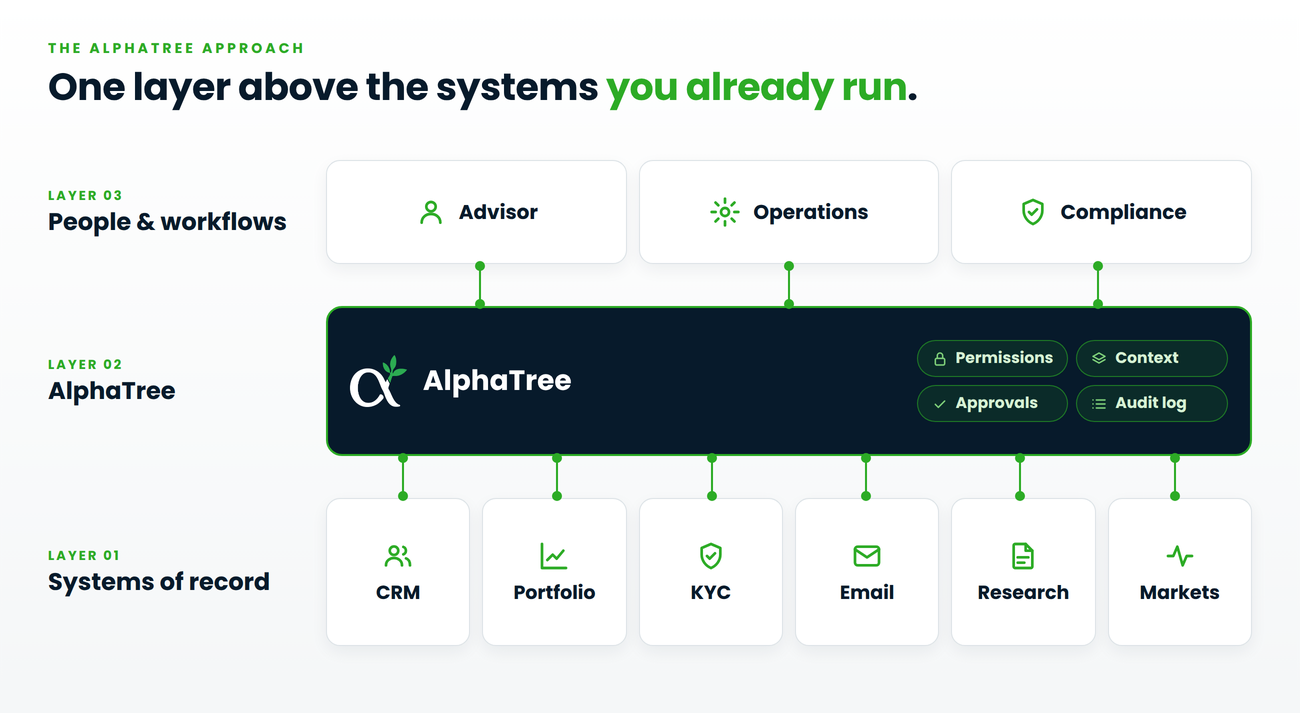
Most firms do not need to discard their existing wealth management technology. They need a configurable layer that sits above it and gathers permitted context. It makes the next useful action easier. That is the role AlphaTree is designed to play.
AlphaTree is not a replacement for your CRM, portfolio or onboarding tools. It is a customisable, AI-first layer shaped around your data, policies and roles. It offers a practical way to bring AI in wealth management into daily operations. You can explore the AlphaTree agentic AI platform for capital markets to see how it fits your tools.
How AI Agents for Financial Services Differ From a Chatbot
A chatbot answers a question. AI agents for financial services can do more within defined boundaries. They plan steps, use approved tools, gather the context needed for a task, check results and hand off to a person when judgement is required.
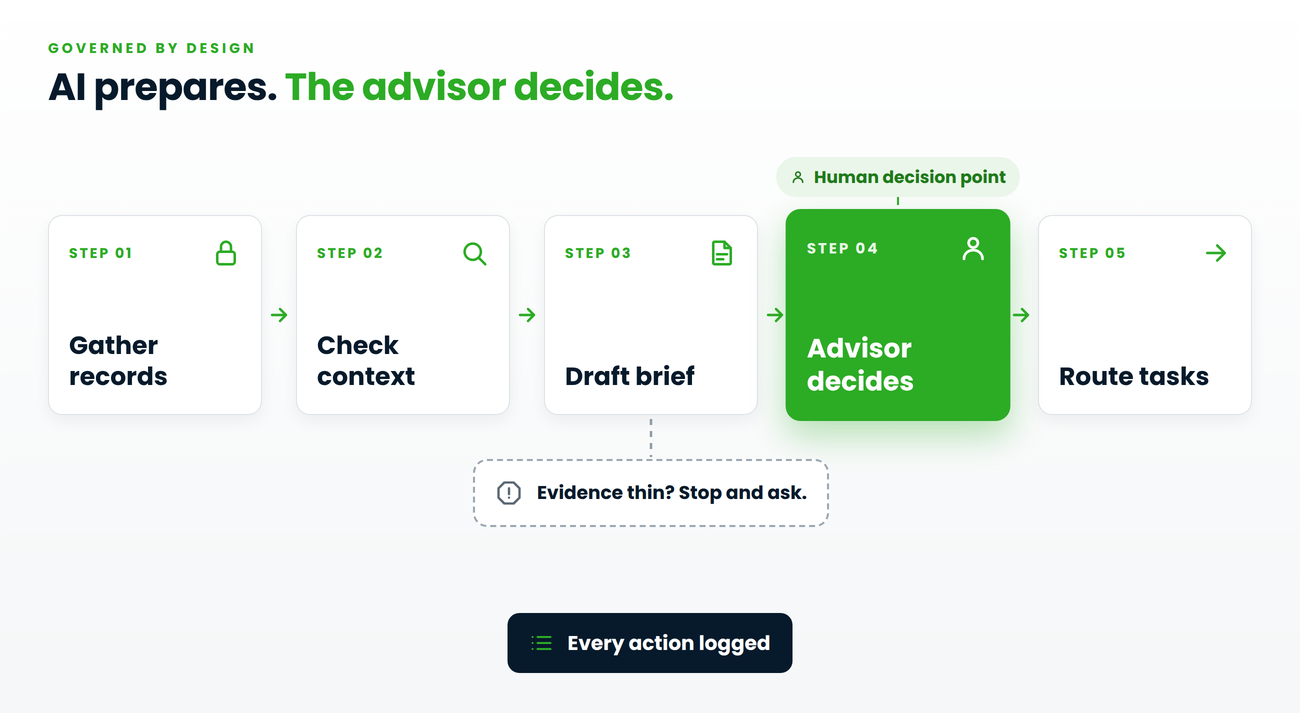
Consider a simple wealth-management workflow before a client review. An agent can gather only authorised client and portfolio information, check relevant investment and service context, prepare an evidence-linked brief and route the next action to the advisor. The advisor decides what to discuss and what action to take. If evidence is missing or permissions do not allow an action, the workflow stops and asks for help.
In a regulated firm, control matters as much as capability. Every action should run through defined permissions, approvals and logs. This is what separates useful AI agents for financial services from a clever demo. The objective is not autonomous advice; it is governed assistance that reduces manual work while preserving accountability.
How AI Tools for Financial Advisors Improve Daily Work
Instead of juggling several log-ins, the advisor receives a concise, evidence-linked brief that brings together the client’s goals and recent contact with portfolio changes, relevant investment insights, market developments, open requests and data gaps. It gives the advisor the supporting evidence behind the most relevant findings, so client context, portfolio context and investment context can be considered together. This is where AI tools for financial advisors show their value.
AlphaTree’s Ira: An AI assistant for relationship managers, is built around this principle. It can help an advisor explore permitted information conversationally, surface relevant context and prepare the next step without quietly making a major investment decision.
In a non-discretionary firm, the agent does not pick investments. Advisors understand client and investment context faster and spend less time on administration, while keeping full responsibility for advice.
A Client Review Example Using AI in Wealth Management
Imagine Meera, an advisor preparing for a review with a long-standing client. Before the meeting, a workflow pulls only the records she is authorised to use. It checks stale onboarding data, reviews relevant portfolio and investment context, and writes a short note linked to its sources. It may also flag an open service request or a change in the client’s goals.
Meera reviews the brief and decides what to discuss. If a holding has changed materially, the brief can point to supporting portfolio information and related research instead of making her search several systems. Afterwards, the workflow drafts tasks through set approvals. If the evidence is thin, it stops and asks for help.
This is responsible wealth management AI: less friction, with the human decision point, source evidence and limits visible.
Where Wealth Management Automation Delivers Value
Wealth management automation works best where handoffs repeat and delay has a clear cost. Strong candidates include lead-to-advisor handoff, annual review preparation, KYC refresh, exception handling and client service requests.
- Lead-to-advisor handoff without re-keying prospect details
- Annual review preparation in a single brief
- KYC refresh and exception handling
- Client service requests that need repeated context gathering
Each has a clear owner and a visible cost when it goes wrong. That makes them practical places to start wealth management automation and sensible early tests for wealth management AI.
KYC Automation as One Practical Use Case
KYC automation is one practical use case because the rules are clear and stale data is costly. The workflow can flag expiring documents, pre-fill details and route gaps to the right team.
A person still approves anything that changes a client’s risk profile. Done well, the workflow also leaves a clean record of who checked what and when. Learn more about our AI-powered client onboarding and compliance solutions.
Governing Wealth Management AI: Agentic Maturity Is an Engineering Discipline
Calling a workflow agentic does not make it production-ready. A mature system decides which tasks use rules, which need a language model and which stay with a person. The real test is simple: can you trust, watch and fix the process when things go wrong?
Responsible AI governance turns that test into concrete controls. The NIST AI Risk Management Framework helps firms map, measure and manage AI risk. For wealth management, that means role-based access, minimal context, constrained tools, approval gates, representative testing, retained evidence and safe human takeover.
| Design concern | A mature implementation | A fragile implementation |
| Model choice | Uses rules or smaller models for simple tasks and stronger models for reasoning. | One model does every task, whatever the risk or cost. |
| Data and privacy | Role and purpose-based access, minimal context, clear retention rules. | A broad data connector behind a general chat interface. |
| Action safety | Constrained tools, allow-lists, approval gates and safe stop conditions. | The agent acts on ambiguous instructions. |
| Evaluation and evidence | Representative testing, retained traces, tracked accuracy. | Success judged from a few impressive demos. |
| Resilience | Plans for missing sources, timeouts and human takeover. | Failures surface only after a client incident. |
Table 1. Production maturity is shown in controls, evaluation and recovery.
In short, responsible AI governance shows in how a system behaves when things go wrong. This discipline is how wealth management AI earns trust. It matters to clients, advisors and regulators alike.
Starting Digital Wealth Management With One Measurable Workflow
Your first wealth management AI use case is usually visible. Start with read, summarise, draft and route capabilities before autonomous action. Pick one workflow with a clear owner, baseline preparation time and rework, test with real users, keep a record of what the system did and why, and expand only when the evidence supports it.
- Pick one workflow with a clear owner.
- Baseline preparation time, turnaround, rework and escalation.
- Test with real cases and real users.
- Keep a clear record of what the system did and why.
- Expand scope only when the evidence supports it.
This makes the business case for wealth management AI easier to measure. Compare real before-and-after numbers, not impressions. For firms that need deeper technical support, AI and machine learning engineering services can help set the data, integration, governance and delivery foundation.
Conclusion: Making Every Client Handoff Intelligent
Good digital wealth management is not about looking automated. It is about being coherent. An intelligent operating layer brings together the right client, portfolio and investment context, supports advisor judgement and keeps consequential actions governed.
Done this way, wealth management AI becomes useful, bounded and easier to explain. Start with one measurable workflow, prove the value, then expand.
Ready to find your first high-value workflow? Book a discovery session with the AlphaTree team. We will help you identify where an intelligent layer can create value.
Frequently Asked Questions About Wealth Management AI
What is wealth management AI actually used for today?
Most firms use wealth management AI to cut manual work and improve how advisors work with client, portfolio and investment context. It can prepare meeting briefs, summarise interactions, surface portfolio or research changes, flag missing documents, draft follow-up tasks and route service requests. It should support decisions rather than quietly make them.
Firms see the strongest value when AI helps financial advisors spend less time searching systems and more time on conversations and decisions that need their judgement.
Is agentic AI safe for regulated advisory firms?
It can be, provided it is engineered with clear boundaries. Safe AI agents for financial services use approved tools and role-based access. They also rely on approval gates and full activity logs. They should stop and ask for help when evidence is weak or a source system is unavailable.
Firms should also test with real cases and track accuracy over time. A single good demo or a vendor claim is not proof of safety.
Does AlphaTree replace our CRM or portfolio management system?
No. AlphaTree is designed to sit above your existing wealth management technology, not replace it. It can connect CRM, portfolio, onboarding and service information so the right context is available in the workflow.
It then gathers the context each person may see and coordinates the next step. This allows wealth management automation to begin without requiring a wholesale migration, while records remain in the systems where teams and auditors expect to find them.
How do we keep AI-assisted actions auditable?
Auditability comes from design, not from reports produced after the fact. For firms using AI in wealth management, strong governance means logging everything. Each retrieval, draft and action is saved with its source, its user and any approval.
Evidence links let reviewers trace a brief back to the underlying data. Clear stop rules also reassure regulators. They show that big decisions stay with accountable people.
Which workflow should we automate first?
In digital wealth management, choose a workflow with repeated handoffs, a clear owner and a delay you can measure. Annual review preparation and KYC automation are popular starting points. The rules are well understood, and the cost of stale or missing data is easy to see.
Start with read, summarise and draft tasks, and capture a baseline. Expand wealth management AI across the firm only once your team trusts the results.